Case study
How we turned manual social platform audits into an agent-first content strategy and marketing insight system
of post history analyzed per audit
report turnaround, start to finish
platforms covered: Instagram, Facebook, YouTube, TikTok
Key takeaways
Their challenge
Every account audit meant a manual pass through months of post performance data across Instagram, Facebook, YouTube, and TikTok by hand: sorting, tagging, and writing up what mattered before a strategic recommendation could go out. It took days per account, and the format was different every time depending on who wrote it.
The solution
- Multi-Platform Ingestion
- Topic Modeling and Clustering
- Evidence-to-Insight Framework
- Best-in-Class Pattern Library
- Platform Mechanics Playbook
- Automated Report Generation
Outcome
Every account now gets the same structured report on demand across every platform it’s live on: evidence-backed insights, a benchmark of what top operators do differently, and a clear strategic direction, without a manual audit cycle.
What they say about 99fold
“We've been working with Matt for several months and I'm 100% satisfied. The communication is fantastic. The results are great. But what I actually value the most is the willingness to make this extra step, this extra mile, to do a little bit more that we've confirmed.”
Marek Didak, Co-Founder, Vox Sapiens
Their challenge
The agency ran social audits for every client account by hand, across Instagram, Facebook, YouTube, and TikTok separately: pulling post performance data, reading through comments and captions, and writing up what worked and what didn’t on each platform before stitching it into one view. It worked, but it didn’t scale past a handful of accounts without adding headcount.
Every audit also looked slightly different depending on who wrote it. Some analysts led with metrics, others with anecdote, and there was no shared benchmark for what “good” looked like on a given platform, so recommendations were opinion more often than evidence.
What the agency needed wasn’t a faster analyst. It needed a system that could read the same volume of data a person could, but turn it into the same structured, evidence-backed report every time, regardless of who kicked it off.
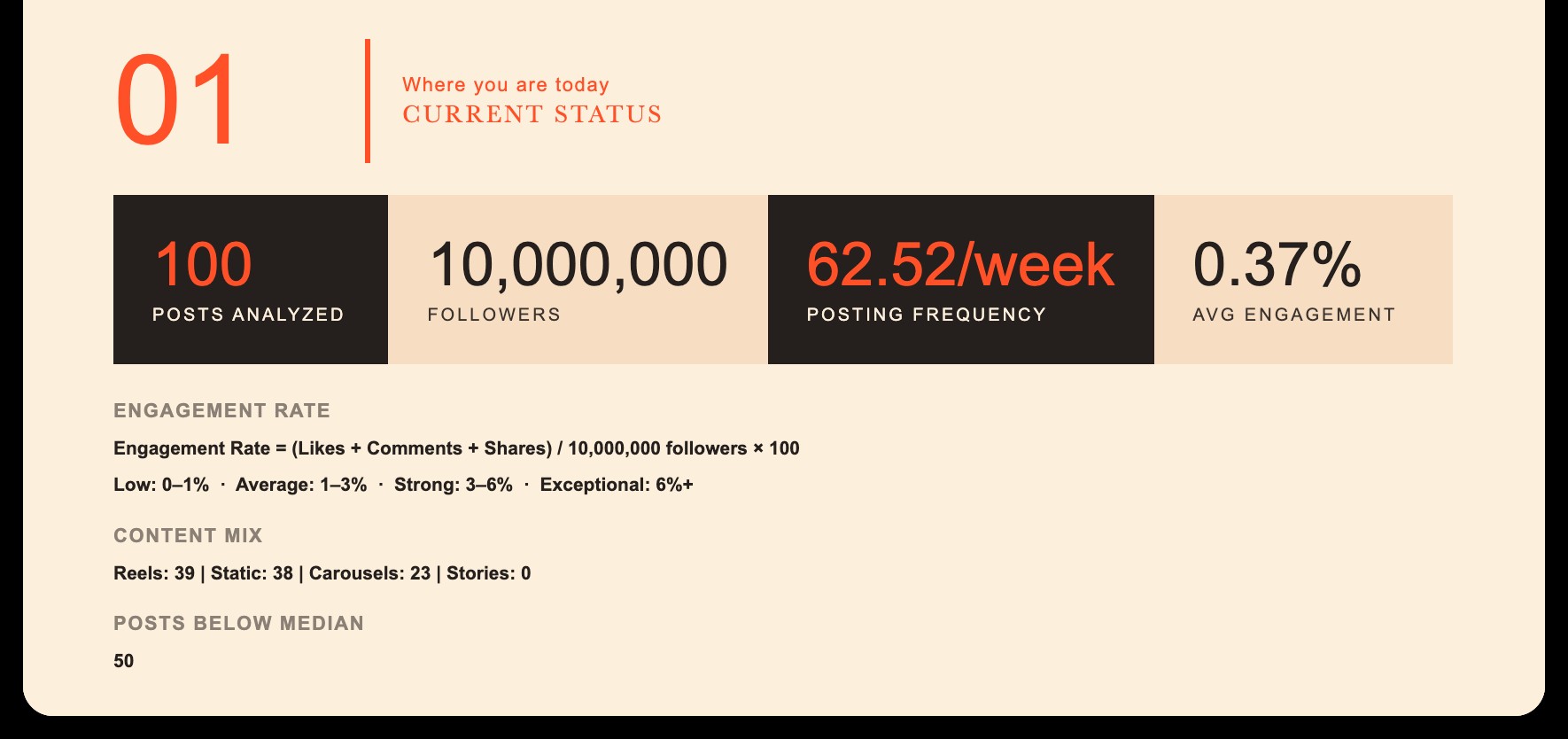
Inside every platform card
Instagram, Facebook, YouTube, and TikTok each get their own card in the same five-metric shape, so accounts are comparable across platforms, not just within one.
- Content mix
- Share of each post type, reels, static, carousel, story, and how each performs against the rest.
- Average engagement
- Mean engagement rate across every post the audit covers.
- Median engagement
- The midpoint engagement rate, so one viral post can't skew the read.
- Posts analyzed
- Total post volume the audit is built on, never a small sample.
- Posting frequency
- How often the account actually ships, benchmarked against the platform norm.
Behind the scenes
The brief called for one system that could take almost no client input, a brand name, a goal, and their social profiles, and turn it into a full audit and strategic brief without a person touching the middle steps. We built it as a pipeline of linked stages, not one large black box, so each part could be tested and re-run on its own.
Every run starts with a short intake capturing the goal, budget, timeline, platforms, and post volume, and gets its own record that everything downstream links back to. That one design choice mattered more than any of the modeling: re-running an account with a new timeframe never overwrites the last result, so the agency can compare audits over time instead of only ever seeing the most recent one.
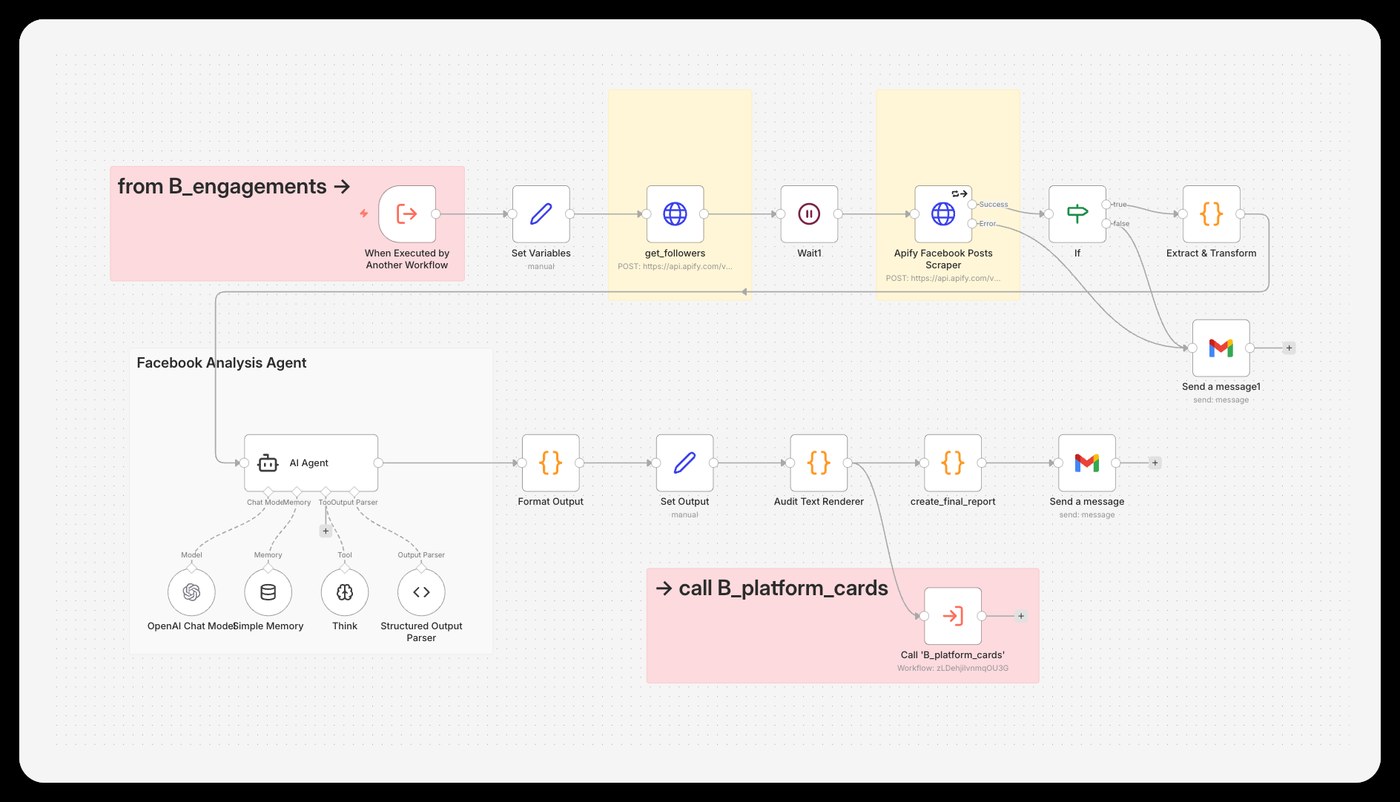
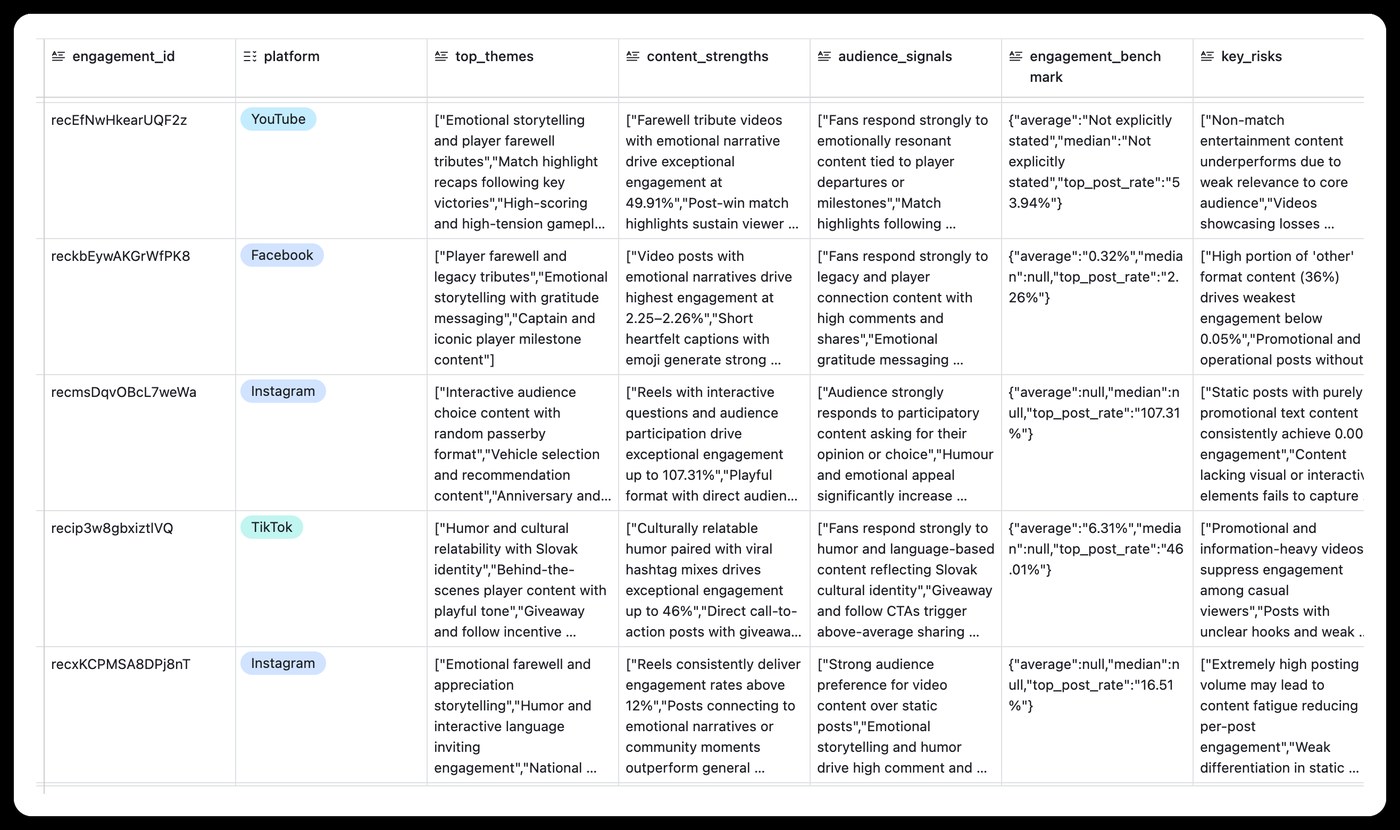
From there, each platform, Instagram, Facebook, YouTube, and TikTok, runs its own audit in parallel and gets distilled into a structured card: top themes, content strengths, audience signals, an engagement benchmark, and key risks, every card in the same shape regardless of platform.
Once every platform card for an account is in, a strategy step reads them all alongside the original brief and produces the strategic insights, positioning, audience segments, and messaging framework in a single pass, the same evidence-to-insight structure whether the account posts twice a week or twenty times.
A final renderer turns that structured output into the report a client actually reads: the metrics grid, the platform-by-platform breakdown, and the opportunities, risks, and recommended direction section, assembled automatically, not written by hand.
What the report surfaces
Opportunities
- The formats and themes already outperforming the account average, and where to double down
- Underused platforms or formats with headroom based on the benchmark library
Risks
- Content patterns quietly dragging the account average down
- Over-reliance on one format or one creator that would hurt if it stopped working
Quick wins
- Changes a team can ship this week with no new production: caption tone, posting time, format mix
- Low-effort fixes flagged separately from longer-term strategic shifts
Key issues
- Root causes, not symptoms: why a pattern is underperforming, not just that it is
- Flagged explicitly in its own section rather than buried in a metrics table
Recommended strategic direction
Every report closes with a single recommended direction, not a list of options: what to prioritize, what to stop doing, and why, in plain language a client can act on the same day.
Before and after
Before
- Every platform, Instagram, Facebook, YouTube, TikTok, audited separately by hand
- Report format varied by whoever wrote it
- Benchmarks were anecdotal, not evidence-backed
- Insights often arrived after the trend had passed
After
- One report per account covering all four platforms side by side
- Every account gets the same structured format
- Every insight ships with evidence and a clear implication
- Trends surface while they're still actionable

Join 2500+ members in my online communities building real agent systems or reach out to me below and start building your agency to run without you.